3  Epigenetics, Ageing Clocks and the Information Theory of Ageing

Of the twelve hallmarks, one increasingly looks less like a peer of the others than like the ground they stand on. This chapter takes up epigenetic alterations — the drift of the chemical marks that hold a cell’s identity in place — and follows it in three directions: into the mechanisms that go wrong, into the clocks that turn that drift into a number, and into the theory that would make the loss of epigenetic information not one cause of ageing among many but the master process beneath several, and the reason ageing can be measured and, perhaps, reversed.

Every cell in your body carries the same genome, yet a neuron and a liver cell could hardly be more different. What distinguishes them is not their DNA sequence but which parts of it are read — a pattern of activation and silencing written not in the letters of the genome but in a layer of chemical marks laid over it. That layer is the epigenome, and the argument of this chapter, and of much of the book, is that ageing is in large part its slow corruption.

Chapter 2 placed epigenetic alterations among the primary hallmarks — the upstream causes of cellular damage — and Chapter 1 proposed that what ageing ultimately erodes is a cell’s identity. Those two claims meet here. If identity is maintained epigenetically, then the decay of the epigenome is where the loss of identity begins, and the question raised in Section 2.5 — whether the hallmarks name causes or symptoms — finds its most concrete test. This chapter is also where ageing becomes quantitative: the epigenetic clock is the field’s most celebrated instrument, and understanding what it does, and what it conspicuously does not do, is essential to reading the rest of the book critically.

3.1 The epigenome: a second code over the genome

The genome is a sequence; the epigenome is everything that governs how that sequence is used without altering a single letter of it. It comprises several interacting systems. DNA methylation adds a methyl group to cytosine bases, usually at CpG sites, and clusters of these (CpG islands) in gene promoters typically switch the associated gene off. Histone modifications decorate the proteins around which DNA is wound; the particular pattern of acetylation, methylation and other marks — the so-called histone code — opens or closes a region to transcription. Chromatin architecture packages the genome into accessible euchromatin and silenced heterochromatin, and folds it in three dimensions so that the right regulatory elements meet the right genes. Non-coding RNAs add a further layer of regulation. Together these systems decide, in each cell, which of the genome’s twenty-thousand-odd genes are expressed.

NoteKey concept — genome versus epigenome

The genome is the inherited DNA sequence: essentially fixed, the same in (almost) every cell, and barely changed over a human lifetime. The epigenome is the overlay of DNA-methylation and chromatin marks that controls gene expression: cell-type-specific, responsive to environment and experience, and — crucially — mutable. This distinction underwrites the whole logic of reversible ageing. You cannot easily rewrite a body’s genome, and would not want to; but if ageing is written in the epigenome, it is in principle erasable, because the epigenome is the layer cells already rewrite all the time.

ImportantAnalogy — the score and the performance

If the genome is a musical score, the epigenome is the performance. The notes on the page do not change from one night to the next, yet the same score yields a luminous interpretation or a ragged one depending on tempo, emphasis and which passages are brought forward or held back. Ageing, in this analogy, is not the loss of notes from the score — the DNA sequence stays largely intact — but the slow degradation of the performance: entrances missed, dynamics flattened, sections that should be silent creeping back in. And because a performance can be re-rehearsed where a lost manuscript cannot be rewritten, the analogy carries the chapter’s central hope as well as its mechanism.

3.2 What changes in the ageing epigenome

Ageing leaves a characteristic, and surprisingly directional, signature across every epigenetic layer (López-Otín et al., 2013, 2023; Sen et al., 2016). Table 3.1 summarises the principal changes; the pattern beneath them is a consistent one — a drift from the crisp, well-insulated regulatory landscape of youth towards a noisier, leakier one.

In DNA methylation, ageing brings a paradoxical pair of changes: a global loss of methylation across the genome’s bulk, alongside focal gains at specific sites — notably the CpG islands of tumour-suppressor genes and Polycomb targets (López-Otín et al., 2023; Sen et al., 2016). The global hypomethylation destabilises the genome and can awaken sequences that should stay silent; the focal hypermethylation can switch off genes that should stay on. In histone modifications, ageing tilts the balance of marks — increases in H4K16 acetylation, H4K20 and H3K4 trimethylation, decreases in the repressive H3K9 and H3K27 trimethylation — eroding the silencing that keeps inappropriate genes shut (López-Otín et al., 2023; Sen et al., 2016). At the level of chromatin architecture, heterochromatin is progressively lost and redistributed, and the three-dimensional organisation of the genome — its lamina-associated domains, topologically associating domains and compartments — deteriorates, dissolving the insulation that normally separates active from silent regions (Yücel & Gladyshev, 2026).

These structural failures have a consequence that recurs throughout the book: the derepression of sequences that ought to be silent. Ancient transposable elements such as LINE-1, normally locked away in heterochromatin, become active in aged cells; their transcripts are sensed by the cell as if they were viral, triggering the cGAS–STING pathway and a sterile, chronic inflammation that links the epigenome directly to inflammageing (Yücel & Gladyshev, 2026). In parallel, a partial opening of enhancers associated with the senescence-associated secretory programme allows the transcription factor AP-1 to colonise sites from which it was previously excluded — a “hijacking” that entrenches an inflammatory, de-identified state and resists reversal (Yücel & Gladyshev, 2026).

Much of the epigenome’s stability rests on pairs of mutually exclusive marks at the same residue or in opposition to one another. The same lysine, histone H3 lysine 27, can carry either a repressive trimethyl mark (H3K27me3, deposited by the Polycomb complex) or an activating acetyl mark (H3K27ac) — never both at once. Likewise the repressive H3K27me3 stands in opposition to the activating H3K4me3 and H3K36me3. These either/or arrangements act as biochemical switches that lock a gene into a stable “on” or “off” state and give the cell a robust memory of its identity (Yücel & Gladyshev, 2026). Their weakness is structural: because the two halves of a switch are co-dependent, the failure of one can collapse the other, so that local noise propagates into global instability. Ageing, on this account, is less a uniform fading than the progressive failure of thousands of such switches — which is why its molecular signature is one of increased variability between cells, not merely a shift in averages. You need not retain the individual marks; the picture to keep is of a cell governed by toggle switches that grow unreliable with age.

Table 3.1: Principal changes in the ageing epigenome, by layer. The unifying theme is a drift from an insulated, low-noise regulatory landscape towards a leaky, high-variability one.
Epigenetic layer Principal change with age Functional consequence
DNA methylation Global hypomethylation; focal hypermethylation at CpG islands of tumour-suppressor and Polycomb genes Genomic instability; aberrant silencing and derepression; substrate of the clocks
Histone modifications ↑ H4K16ac, H4K20me3, H3K4me3; ↓ H3K9me3, H3K27me3 Loss of silencing; transcriptional noise
Heterochromatin Loss and redistribution (↓ HP1α, ↓ H3K9me3) Derepression; transposon reactivation; instability
3D genome organisation Erosion of LADs, TADs and compartments Loss of regulatory insulation; enhancer mis-wiring
Transposable elements LINE-1 derepression cGAS–STING activation; sterile inflammation
Transcriptional control AP-1 enhancer hijacking; SASP enhancers opened Loss of cell identity; entrenched inflammation

3.3 From change to clock: measuring biological age

The most consequential application of all this is also the simplest in principle. If methylation changes track ageing reliably, then a weighted reading of methylation at the right sites should estimate how old a tissue is, biologically — and it does, with startling accuracy. This is the epigenetic clock, and it has come in distinct generations, each correcting a limitation of the last.

The first generation trained the clock to predict chronological age. Horvath’s 2013 multi-tissue predictor estimated age across more than fifty tissue types from a few hundred methylation sites, and was close to zero in embryonic and induced pluripotent stem cells — a hint, returned to below, that ageing has a resettable point (Horvath, 2013). Hannum’s contemporaneous clock did the same in blood (Hannum et al., 2013). These clocks were accurate but conceptually limited: trained on the calendar, they could only ever rediscover it, and the interesting cases — people ageing faster or slower than their years — were treated as error.

The second generation turned that error into the signal. Rather than predicting chronological age, these clocks were trained on health and mortality. PhenoAge distilled clinical markers of physiological ageing into a methylation estimator of biological age (Levine et al., 2018); GrimAge went further, training on surrogate measures and predicting lifespan and healthspan with notable power (A. T. Lu et al., 2019). A third generation shifted from a snapshot to a rate: DunedinPACE, built from two decades of within-person decline across nineteen organ systems, estimates not how old you are but how fast you are ageing — a speedometer rather than an odometer (Belsky et al., 2022). The reach of the approach is striking: a universal methylation clock now spans the mammals, from mouse to whale, implying a deeply conserved ageing process beneath the species differences (A. T. Lu et al., 2023).

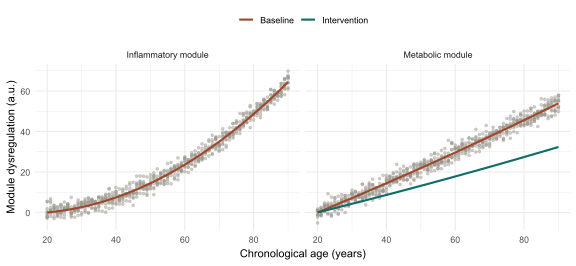
The newest frontier moves beyond methylation altogether. A 2026 study integrating more than eleven thousand transcriptomes across twenty-five tissues and four mammalian species built clocks not from methylation but from gene-expression signatures, predicting chronological age, expected mortality and the effects of lifespan-altering interventions, with conserved markers such as CDKN1A and galectin-3 whose protein levels tracked mortality and multimorbidity in the UK Biobank (Tyshkovskiy et al., 2026). Its deeper contribution is conceptual: it decomposes ageing into modules — inflammation, energy metabolism, extracellular-matrix organisation — each with its own clock, and shows that different diseases and interventions act through distinct modules. Figure 3.1 develops this idea in a simple simulation, and with it the single most important caveat about clocks: that “biological age” is not one number.

Show the simulation code
library(ggplot2)
set.seed(7)

ages <- 20:90

# Mean trajectories of two ageing 'modules' (arbitrary units of dysregulation)
traj <- function(age, slope, accel) slope * (age - 20) + accel * (age - 20)^2
infl_mu  <- traj(ages, slope = 0.15, accel = 0.0110)   # inflammation: accelerates late
metab_mu <- traj(ages, slope = 0.70, accel = 0.0010)   # metabolism: earlier, ~linear

# A cross-sectional cohort of individuals (biological variation at each age)
n <- 10
cohort <- function(mu, noise) data.frame(
  age   = rep(ages, each = n),
  score = rep(mu, each = n) + rnorm(length(ages) * n, 0, noise)
)
pts <- rbind(
  data.frame(module = "Inflammatory module", cohort(infl_mu,  2.4)),
  data.frame(module = "Metabolic module",    cohort(metab_mu, 2.4))
)

# Mean lines, plus a metabolism-targeting intervention (~40% slower metabolic drift)
metab_cr <- traj(ages, slope = 0.42, accel = 0.0006)
lines <- rbind(
  data.frame(module = "Inflammatory module", regimen = "Baseline",     age = ages, score = infl_mu),
  data.frame(module = "Metabolic module",    regimen = "Baseline",     age = ages, score = metab_mu),
  data.frame(module = "Metabolic module",    regimen = "Intervention", age = ages, score = metab_cr)
)

ggplot() +
  geom_point(data = pts, aes(age, score), colour = "#9A968C", alpha = 0.45, size = 1) +
  geom_line(data = lines, aes(age, score, colour = regimen), linewidth = 1) +
  scale_colour_manual(values = c("Baseline" = "#9C4A2E", "Intervention" = "#0F6E66")) +
  facet_wrap(~module) +
  labs(x = "Chronological age (years)", y = "Module dysregulation (a.u.)", colour = NULL) +
  theme_minimal(base_size = 11) + theme(legend.position = "top")
Figure 3.1: Modular ageing, simulated. Two notional molecular ‘modules’ — an inflammatory module that accelerates late in life and a metabolic module that rises earlier and more steadily — drift at different rates (grey points: simulated individuals in a cross-sectional cohort; coloured lines: mean trajectories). Two lessons follow. First, individuals of the same chronological age occupy a wide band of biological states, which is the basis of the clocks and the reason chronological age alone is a blunt instrument. Second, an intervention (here a dietary-restriction-like effect, teal) can slow one module while leaving another untouched — so no single clock captures ageing as a whole, and no single drug is likely to fix it. This is the practical meaning of the modular architecture reported by Tyshkovskiy et al. (2026).

3.4 Do the clocks measure a cause?

A clock that predicts mortality is an extraordinary instrument. But prediction is not explanation, and the question that haunts the field is whether the methylation marks the clocks read are driving ageing or merely recording it. The honest answer, stated plainly even by the framework’s architects, is that the changes are robustly associated with ageing but that there is no definitive evidence they cause it (López-Otín et al., 2023).

CautionCaveat — what the clocks do and do not tell you

An epigenetic clock is a correlation engine, and three limits follow. First, accuracy is not mechanism: a clock can predict death without identifying a single causal lever, just as a falling barometer predicts storms without causing weather. Second, the generations measure different things — chronological age, biological age, and the pace of ageing are not interchangeable, and a study that conflates them can mislead. Third, and most unsettling, recent work shows that much of what the clocks track may be stochastic: ageing clocks can be built from the accumulation of essentially random epigenetic variation (Meyer & Schumacher, 2024; Tong et al., 2024), which raises the possibility that a clock measures noise that rises predictably with time rather than a programme that could be switched off. Whether epigenetic ageing is better read as programmatic or as accumulating stochastic damage is an active and unresolved debate (Gems & Magalhães, 2024). A clock is a thermometer, not a diagnosis; treat a number that goes down under an intervention as a hypothesis, not a cure.

And yet the clocks do something a pure correlate should not: they can be turned back. Interventions from thymus regeneration to dietary supplements have lowered epigenetic age in human pilot studies, and — most dramatically — the partial reprogramming examined in Chapter 8 resets the clock in animals while restoring function (Y. Lu et al., 2020). That a manipulation of the epigenome moves the clock and rejuvenates the tissue is the strongest available hint that the marks are closer to cause than to bystander. It is a hint, not a proof; but it is the hinge on which the book’s central possibility turns.

3.5 The information theory of ageing

The boldest attempt to convert that hint into a theory belongs to the laboratory of David Sinclair. Its claim is that ageing is driven less by the loss of genetic information — mutations to the DNA sequence — than by the loss of epigenetic information: the orderly arrangement of marks that constitutes a cell’s record of what it is (Yang et al., 2023).

The supporting experiment is ingenious. Using a mouse engineered so that researchers could induce and then track epigenetic disruption — the ICE system, for inducible changes to the epigenome — Yang and colleagues showed that the cell’s own machinery for repairing DNA breaks is the agent of decay. Each time a break is mended, the proteins that maintain the epigenome are transiently pulled away to the site of damage and do not all return to exactly where they were. Over a lifetime of repair, this relocalisation scrambles the cell’s regulatory information. The ICE mice aged faster by physiological, cognitive and molecular measures — without any increase in mutations — and, critically, some of those changes were reversed by a pulse of reprogramming factors (Yang et al., 2023).

ImportantAnalogy — data corruption and the master copy

Imagine the cell’s identity stored like a digital recording. Genetic damage would be a scratch on the disc — physical, irreversible, a loss of the underlying data. Epigenetic ageing is different: the data are intact, but the index that says which track to play, and how loudly, is gradually corrupted, so the recording plays back muddled even though nothing is missing. The information theory makes two claims about this picture. The pessimistic one is that the corruption accumulates relentlessly with every act of maintenance. The optimistic one is decisive: if a clean master copy of the index survives somewhere in the cell, the original performance can be restored — which is precisely what reprogramming appears to do. Ageing, on this view, is a software problem, not a hardware failure, and software can be rebooted.

The theory is contested — it rests substantially on engineered systems, and the existence and nature of any retrievable “backup” of youthful information remain open questions. But it reframes the entire enterprise. If ageing is lost information rather than accumulated damage, then the goal of intervention is not to repair every broken part but to restore the instructions, and the resettable, near-zero clock of the embryo and the stem cell (Horvath, 2013) becomes evidence that such a reset is biologically possible.

3.6 Epigenetic ageing as systemic loss of fidelity

The information theory identifies a mechanism; a still broader synthesis tries to specify the system that fails. Recent work proposes that epigenetic ageing is best understood not as the independent failure of methylation, or histones, or chromatin folding, but as a coordinated breakdown of epigenetic fidelity — the capacity of the cell’s interlocking chromatin systems to preserve gene-expression programmes accurately over time and through perturbation (Yücel & Gladyshev, 2026).

NoteKey concept — epigenetic fidelity

Epigenetic fidelity is the reliability with which a cell maintains the correct pattern of gene activity across divisions and stresses. Its loss is epigenetic drift: the derepression of lineage-inappropriate genes, biased differentiation, rising cell-to-cell variability and, ultimately, the loss of cell identity that this book takes as the signature of ageing. The reframing matters because it shifts the target from a list of marks to a property of the system — and a system’s reliability can be supported as a whole, not only patched site by site.

On this account, fidelity is maintained by four interdependent processes whose joint failure produces drift: the integrity of the three-dimensional genome, the balance of the antagonistic histone switches, the patterning of DNA methylation, and the stability of the transcription-factor networks that read them (Yücel & Gladyshev, 2026). The framework also supplies a striking proof of principle that supporting the system slows ageing: the transcription factor FOXM1, which restrains the AP-1 enhancer hijacking described earlier, extends both median and maximum mouse lifespan by nearly thirty per cent when expressed in pulses — slowing epigenetic erosion to slow ageing itself (Yücel & Gladyshev, 2026). Read together with the information theory, this completes the chapter’s argument: epigenetic alterations are not one hallmark among twelve but the substrate on which several of the others are written, and the loss of cell identity foreshadowed in Chapter 1 has, in epigenetic fidelity, a concrete and increasingly tractable name (Ciaglia et al., 2025).

3.7 From reading to rewriting

If ageing is corrupted epigenetic information, the therapeutic logic is to rewrite it — and unlike the genome, the epigenome is designed to be written. Three approaches follow, and the rest of Part III elaborates them. The most radical is epigenetic reprogramming, the controlled, pulsed application of identity factors to restore youthful patterns of expression, whose central problem is one of dosage and control (Section 8.2) and whose mechanism is precisely the reset this chapter has described. More conventional are the epigenetic drugs — inhibitors of the methyltransferases and histone deacetylases that already exist, largely from oncology, as agents for redirecting a cell’s expression programme (Marei, 2025). And on the horizon is targeted epigenetic editing, which would rewrite specific marks at specific loci rather than resetting the cell wholesale. All three rest on the same foundation laid here: that the layer ageing corrupts is the one layer cells were built to revise.

We have followed a single hallmark down to the level where ageing becomes both measurable and, in principle, reversible — and found that it is not really a single hallmark at all, but the informational substrate beneath several. The epigenome’s drift can be read as a clock, debated as a cause, theorised as lost information and synthesised as a failure of fidelity; and at each step the same conclusion recurred, that the layer corrupted in ageing is the layer cells already rewrite.

The next chapter turns to two hallmarks that the epigenome’s decay helps set in motion. The erosion of the chromosome’s protective ends — telomere attrition — is itself an epigenetically governed process, and the arrested, inflammatory cells it helps produce, the senescent cells whose secretions inflame ageing tissue, are downstream of exactly the enhancer hijacking and identity loss described here. From the cell’s corrupted instructions, we move to the cells that can no longer divide and will not die.